

What Percent Of The Animal Kingdom Do Vertebrates Makeup Ray Finned Fish
Jon Weinstein and Lance Grande, Field Museum of Natural History
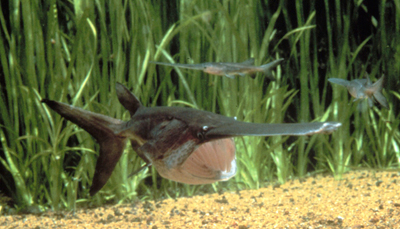
A juvenile paddlefish filter feeds in a tank at Shedd Aquarium, Chicago.
Although humans experience the world through five senses, sharks, paddlefishes and certain other aquatic vertebrates have another sense: They can find weak electrical fields in the water and use this information to find casualty, communicate and orient themselves.
Now, a study in the Oct. 11 outcome of Nature Communications that caps more than 25 years of work finds that the vast bulk of vertebrates -- some 30,000 species of land animals (including humans) and a roughly equal number of ray-finned fishes -- descended from a common ancestor that had a well-developed electroreceptive system.
This antecedent was probably a predatory marine fish with good eyesight, jaws and teeth and a lateral line arrangement for detecting water movements, visible as a stripe forth the flank of most fishes. It lived effectually 500 one thousand thousand years ago. The vast majority of the approximately 65,000 living vertebrate species are its descendants.
Willy Bemis
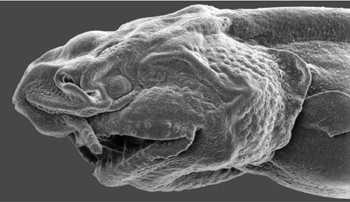
A scanning electron micrograph of the head of developing paddlefish shows pores of the lateral line and electroreceptive organs.
"This study caps questions in developmental and evolutionary biology, popularly called 'evo-devo,' that I've been interested in for 25 years," said Willy Bemis, Cornell professor of ecology and evolutionary biology and a senior author of the paper. Melinda Modrell, a neuroscientist at the University of Cambridge who did the molecular assay, is the paper'southward lead author.
"The crucial pieces came from techniques of developmental and molecular biology. Such a synthesis of modern techniques, classical questions and bones beefcake is the cornerstone of 'evo-devo' inquiry, and it promises to help united states better understand the origin and evolution of many organ systems, including the brain," Bemis added.
Hundreds of millions of years ago, at that place was a major separate in the evolutionary tree of vertebrates. One lineage led to the ray-finned fishes, or actinopterygians, and the other to lobe-finned fishes, or sarcopterygians; the latter gave rising to land vertebrates, Bemis explained. Some country vertebrates, including such salamanders as the Mexican axolotl, have electroreception and, until now, offered the best-studied model for early evolution of this sensory system. As part of changes related to terrestrial life, the lineage leading to reptiles, birds and mammals lost electrosense besides every bit the lateral line.
Some ray-finned fishes -- including paddlefishes and sturgeons -- retained these receptors in the skin of their heads. With equally many as seventy,000 electroreceptors in its paddle-shaped snout and skin of the caput, the N American paddlefish has the most extensive electrosensory assortment of any living animal, Bemis said.
Until now, it was unclear whether these organs in different groups were evolutionarily and developmentally the same.
Using the Mexican axolotl as a model to represent the evolutionary lineage leading to country animals, and paddlefish as a model for the co-operative leading to ray-finned fishes, the researchers plant that electrosensors develop in precisely the same blueprint from the same embryonic tissue in the developing skin, confirming that this is an ancient sensory arrangement.
The researchers also found that the electrosensory organs develop immediately adjacent to the lateral line, providing compelling evidence "that these two sensory systems share a common evolutionary heritage," said Bemis.
Researchers can now build a motion-picture show of what the common ancestor of these two lineages looked like and improve link the sensory worlds of living and fossil animals, Bemis said.
Co-authors include Glenn Northcutt, a world expert on vertebrate neuroanatomy based at the Scripps Institution of Oceanography; and Claire Baker at the University of Cambridge, whose lab contributed molecular analyses.
The study was funded by the Biotechnology and Biological Sciences Research Quango in the United Kingdom, National Institutes of Health, National Science Foundation, Whitehall Foundation and Tontogany Creek Fund.
Source: https://news.cornell.edu/stories/2011/10/most-vertebrates-descended-ancestor-sixth-sense
Posted by: parkeywhicess.blogspot.com
0 Response to "What Percent Of The Animal Kingdom Do Vertebrates Makeup Ray Finned Fish"
Post a Comment